As ongoing efforts to disenfranchise voters ramp up, please consider this a reminder and a warning:
History is not linear.
Progress is not permanent.
We must remain aware and active to protect the progress that has been made.
Mobile, Alabama is not top of the mind when we talk Civil Rights or Voting Rights, but it has a LONG history. Today I will share one moment in time. On April 3, 1944, the Texas Supreme court ruled on Smith v. Allwright. It declared the white only Democratic primary was unconstitutional.
The ruling argued “that the exclusion of Negroes from voting in a Democratic primary to select nominees for a general election — although, by resolution of a state convention of the party, its membership was limited to white citizens — was State action in violation of the Fifteenth Amendment.” The Fifteenth Amendment ratified in 1870 prohibited voter discrimination “on account of race, color, or previous condition of servitude.”
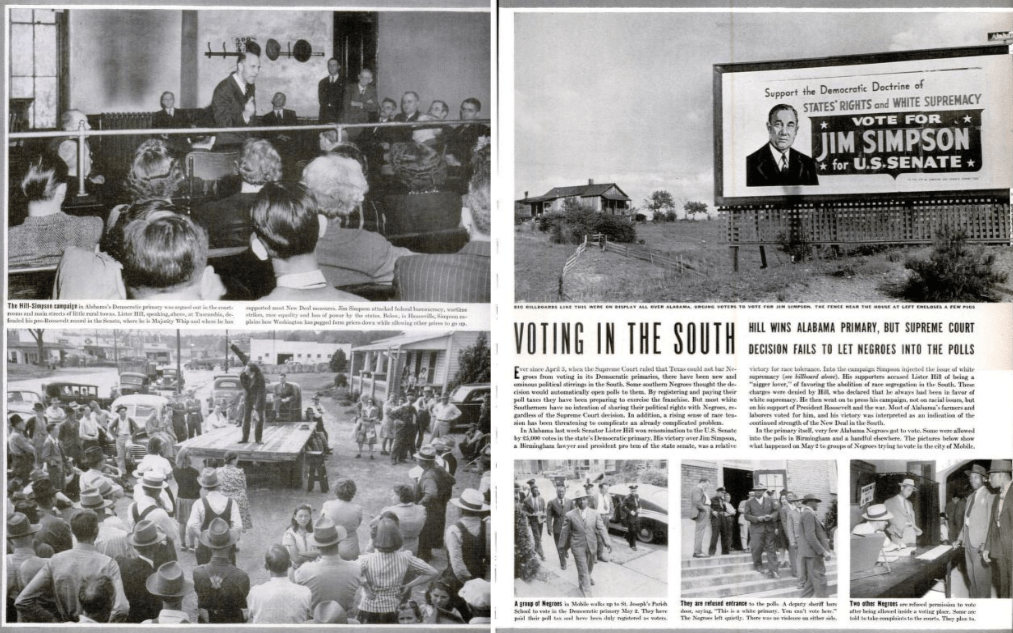
Knowing that there would be resistance because Mobile had a history of resisting racial equality, the Mobile NAACP was prepared. The Mobile NAACP Branch was a politically active, astute, and award winning branch. They arranged to have the historic moment documented for perpetuity, but more urgently, legal strategy. Life Magazine reporters were brought to document the first Democratic Primary, post Smith v. Allwright, that allowed Black voters to participate.
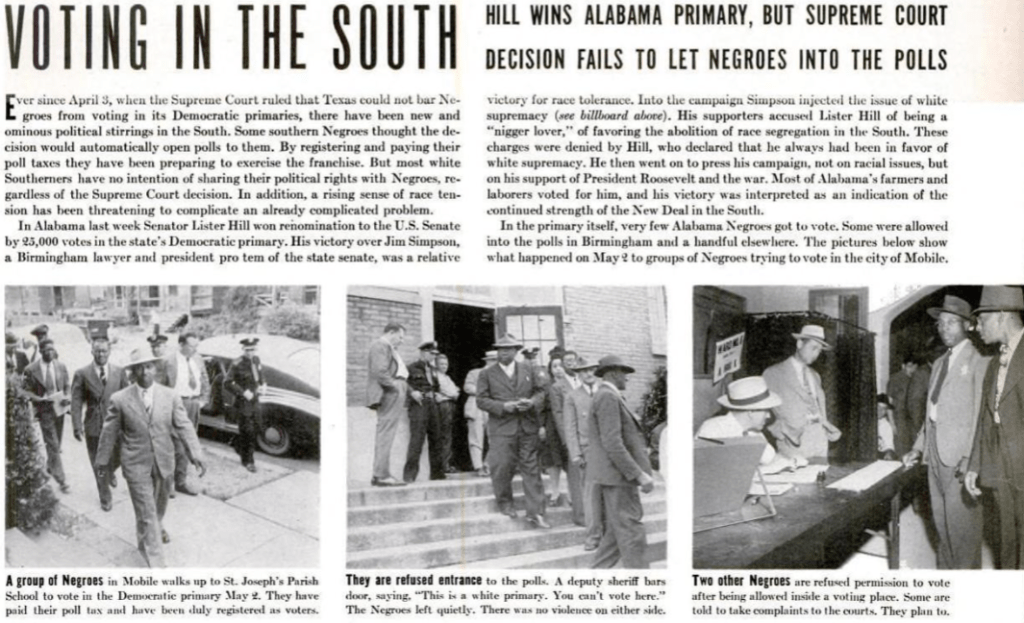
The ruling came down in April. The images circulated the world in May. Life observed “Some Southern Negroes thought the decision would automatically open polls to them. By registering and paying poll taxes they have been preparing to exercise the franchise. But most white Southerners have no intention of sharing their political rights with Negroes, regardless of the Supreme Court decision.”
As WWII raged, Black soldiers fought and died for Democracy abroad while many were deprived of democracy at home. You could take a bullet for your country, but not cast a ballot. The incongruency between actions and ideals was on full display for the world to see. The international embarrassment, future me will argue, drove Mobile to ramp up the propaganda on it’s “good race relations” that has dominated the historic record.
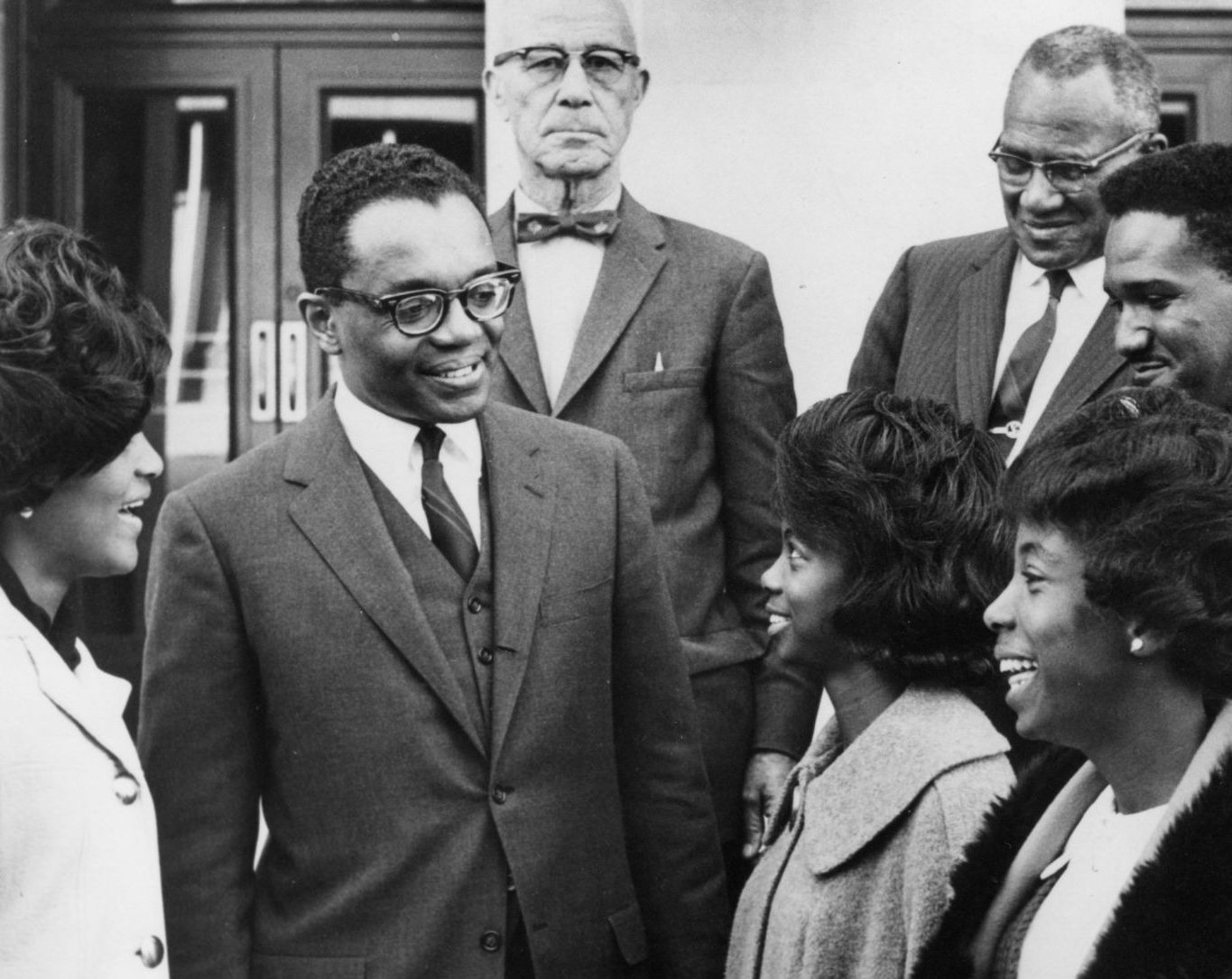
Wiley Bolden (second row left ) standing next to John L. LeFlore at the conclusion of the Birdie Mae Davis school desegregation case. Image Courtesy of the Doy Leale McCall Rare Book and Manuscript Library.
In a joint interview, activists and NAACP officers, John L. LeFlore and Wiley Bolden, discussed the preparation for the big day. The photographers “conferred with us on the eve of the primary, on the day before, and we agreed that we would be at certain wards at certain hours in the afternoon.” The photos were captured at St. Joseph’s Parish School. LeFlore himself was among those blocked from voting in the primary that day. Although, by virtue of the Supreme Court’s ruling, it was no longer a white primary, voters were still told “This is a white primary. You can’t vote here” and to “take complaints to court.” They did. “We worked all evening on those affidavits,” Leflore said. Bolden and LeFlore believed the images and their widespread circulation contributed to efforts to end voter discrimination. The Department of Justice subsequently got involved, but the struggle continued(s).
The Boswell Amendment, adopted in 1946, two years after Smith v. Allwright, required one to read and interpret a part of the constitution to register to vote. The voting registrar had the power to enforce the rule or not, select the passage, and assess the accuracy of the answer. Because Alabama is always on the right side of history, The Boswell Amendment which culminated in a courtroom showdown of Matlock proportions (of which we will revisit) was highlighted in the National Park Service’s Voting Rights Historic Context. The Boswell episode, it was said, “provides a prime example of how the system worked.” Inventing new ways to exclude or resurrecting old ones is how the ruling class maintained(s) its power. That amendment was struck down a few years later. But no, that was not the end either. LeFlore and Bolden would continue to fight for voting rights decades more. We must be as steadfast as Bolden, LeFlore, and all the others in our commitment to eradicating barriers as others are committed to erecting them. The end has yet to come.
It’s just like just like whack-a-mole but without harming cute fuzzy creatures. Stay vigilant folks..
Sources:
Doy Leale McCall Rare Book and Manuscript Library:
LeFlore, John L.; Bolden, Wiley; and McLaurin, Melton, “JLFC 002 John LeFlore & Wiley Bolden 8-7-1970” (1970). John LeFlore Collection (JLFC). 5
LeFlore, John L. and McLaurin, Melton, “JLFC 001D John L LeFlore 10-9-1972” (1972). John LeFlore Collection (JLFC). 4.
National Park Service, U.S. Department of the Interior. Civil Rights in America: Racial Voting Rights. A National Historic Landmarks Theme Study (2009).
Life Magazine May 5-15, 1944 Vol. 16 no. 20, pgs 32-34
Smith v. Allwright | 321 U.S. 649 (1944) | Justia U.S. Supreme Court Center
 preserve black alabama
Leave a comment